Research
My research interests revolve around the study of non-Hausdorff manifolds, and their potential application to problems of topology change in quantum gravity. Here’s a brief summary for the curious mathematician:
Topologically, non-Hausdorff manifolds can always be realised as a union of Hausdorff ones — if you are feeling Zorn-y then you can take a cover by open charts and extend it into a cover by maximal open Hausdorff submanifolds, and if you are feeling particularly fancy then you can represent non-Hausdorff manifolds as a colimit in the category TOP. The latter is a nice approach, because it informs us of how to carry other geometric data of interest over into the non-Hausdorff setting. Locally-defined geometry passes over without issue, but global features are pathological — things like Stokes’ Theorem, integral results such as the Gauss-Bonnet Theorem, and the general cohomology of non-Hausdorff manifolds become tricky without access to arbitrarily-existent partitions of unity. But, these global constructions are indeed possible and now well-understood.
Once all of the geometric structure is defined and properly characterized, we can start to ask bold questions like “what would a non-Hausdorff spacetime look like?” The short answer is something like below, where here the level sets are displayed on the right hand side:
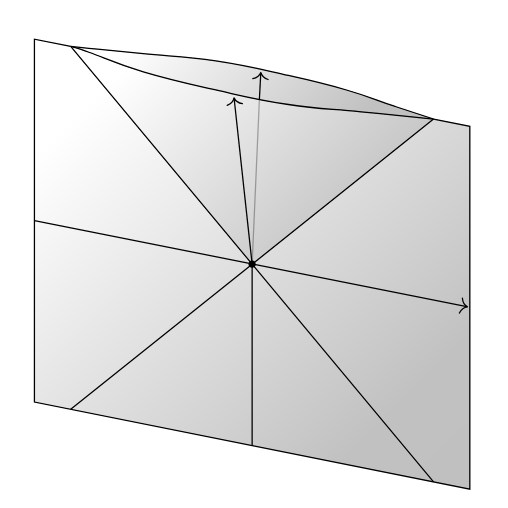
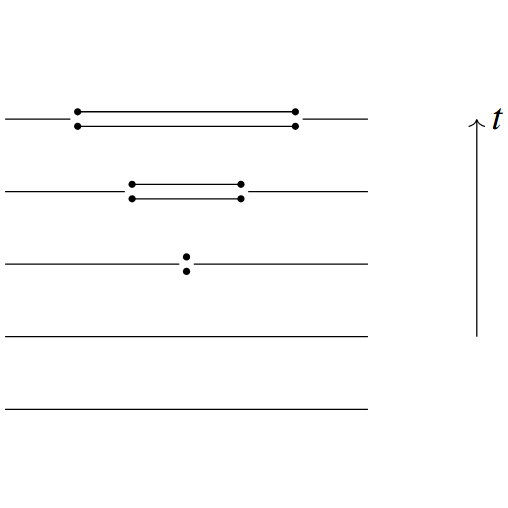
My main interest is in building a theory of physics based off of these weird guys. Mostly I care about the inclusion of these spaces into a path integral for gravity in Lorentzian signature, since there is always a question of which topologies to sum over in the path integral, and it appears as though objects like the above ought to be preferred over conventional topology-changing spacetimes such as the almost-Lorentzian cobordisms. In the past, I have studied the potential inclusion of these non-Hausdorff spacetimes within a path integral for gravity in 2d (which can be found here).
These days, I am mostly thinking about categorical extensions of QFTs into the non-Hausdorff setting. The idea sounds difficult, but it’s really not: if we restrict our attention to particular non-Hausdorff colimits in some nice-enough category of globally-hyperbolic spacetimes that already admit a locally-covariant QFT, then the real question boils down to the correct choice of non-Hausdorff test functions, and the correct categorical construction to impose on all the 
Dare I say it, I may even venture into some non-non-Hausdorff geometry some time soon — I am curious about the Index Theory of almost-Lorentzian cobordisms, since I refined a proof of the Lorentzian Gauss-Bonnet Theorem semi-recently. It would be interesting to see how much of the discrete approach is “smoothable” and generalizes to a Lorentzian version of the Atiyah-Singer Index Theorem. If you are interested in this then please reach out!
 Mathematics et al.